

Apple integrates AI-powered Auto Mask for frame-based isolation in Final Cut Pro
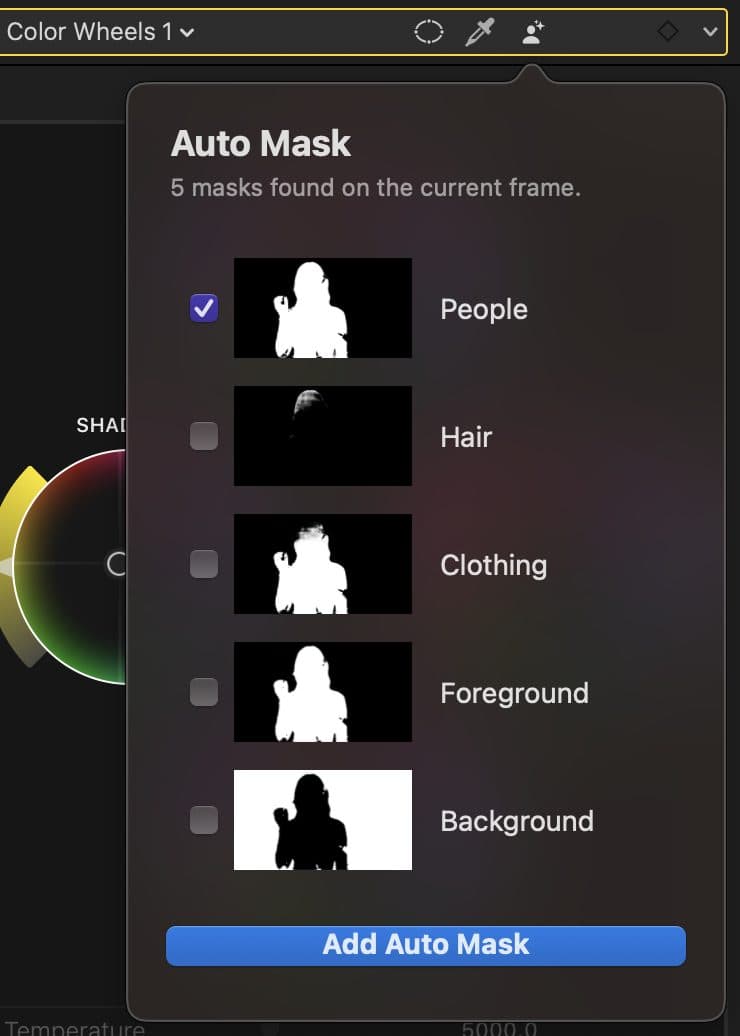
Apple has added a frame-based 'Auto Mask' feature to Final Cut Pro that utilizes AI to automatically identify and isolate 17 distinct subjects, including people, animals, and scene elements. This feature enables editors to apply selective color correction and effects without relying on traditional manual motion tracking.
Key Takeaways
- Identifies 17 specific mask categories including anatomical parts (lips, teeth, eyebrows), scene elements (sky, foliage), and animals (cats, dogs).
- Uses frame-by-frame AI recognition rather than traditional motion tracking, making it highly resistant to subject occlusion.
- Integrated directly into effect headers, allowing users to apply masks to any built-in effect or color correction tool.
- Enables complex Boolean operations by adding, subtracting, or intersecting multiple masks within a single clip.
Why It Matters
The introduction of Auto Mask signals a shift from manual rotoscoping and tracking to automated, object-aware editing. By removing the need to manage tracking points or keyframes for basic isolation, Apple is reducing the high-friction labor historically required for high-end color grading. This move intensifies the AI arms race against Adobe Premiere Pro’s Object Mask and DaVinci Resolve’s Magic Mask, focusing on speed and on-device processing. For the broader ecosystem, it establishes a new baseline for Prosumer NLEs where semantic recognition—understanding 'what' is in the frame—replaces geometric tracking as the standard for local adjustments. Watch for Adobe to counter with more advanced Generative Fill integrations to maintain its market lead in complex compositing.
Additional Context
The rollout of Auto Mask in Final Cut Pro 12.3 is part of a broader 'Apple Creator Studio' initiative aimed at consolidating professional workflows on Apple silicon. Released in June 2026, the update further positions FCP as a subscription-free alternative to Adobe Creative Cloud, especially through its tight integration with Pixelmator Pro for thumbnail and graphics creation, as noted by PetaPixel in July 2026. This version also introduced AI-generated captions and Edit Detection, utilizing the Neural Engine to perform heavy transcription and scene analysis locally rather than in the cloud.
Competitively, Apple is closing the gap with Blackmagic Design, which unveiled DaVinci Resolve 21 and version 20 at NAB 2025 with massive updates to its Magic Mask and new 'AI Face Age' transformers. Meanwhile, Adobe released Object Masks for Premiere Pro in late 2025, attempting to bridge the gap between video editing and specialized compositing. Per Digital Camera World, the addition of manual control over mask detection (hover-and-select) in FCP 12.3 addresses a long-standing request from editors who found fully automated tracking tools inconsistent in complex lighting.
Technically, Apple has also shifted its backend efficiency, moving proxy generation to HEVC by default to improve HDR support. External capture support has expanded via the Final Cut Camera app, which added Clean HDMI Out and ProRes LT capabilities in 2026 to support professional monitoring workflows. These combined updates suggest Apple is focusing on high-speed, on-device AI to appeal to creators working with high-resolution spatial video from the Vision Pro and iPhone 15 Pro onwards.
Read full article at provideocoalition.com
Enjoy our coverage?
Add StreamingMeme as a preferred source on Google to see more of our streaming news at the top of your Search results.
Add as preferred source