StreamingMemeStreamingMemeBuyers Guide
AboutLeaderboardsEventsSubmit News
Subscribe

Daily Brief

The streaming industry in your inbox every morning.

Daily Brief

The streaming industry in your inbox every morning.

StreamingMemeStreamingMeme

The independent buyers guide and news aggregator for the streaming technology industry.

Explore

Buyers GuideLeaderboardsEventsSubmit News

Stay updated

Weekly digest of new companies and streaming news.

Categories

Encoding & SoftwareVideo Delivery & CDNStreaming PlatformsAI for VideoProduction HardwareBusiness NewsMonetization & Ad TechRegulatory & Policy

© 2026 StreamingMeme. All rights reserved.

AboutPrivacy PolicyTermsContact
EncodingCDNPlatformsAI & VideoHardwareBusinessAd TechPolicy
← AI for Video
AI & VideoTechnical DevelopmentJune 16, 2026

AMD extends FSR 4.1 to RDNA 3 and RDNA 2 GPUs
AMD extends FSR 4.1 to RDNA 3 and RDNA 2 GPUs
Wccftech

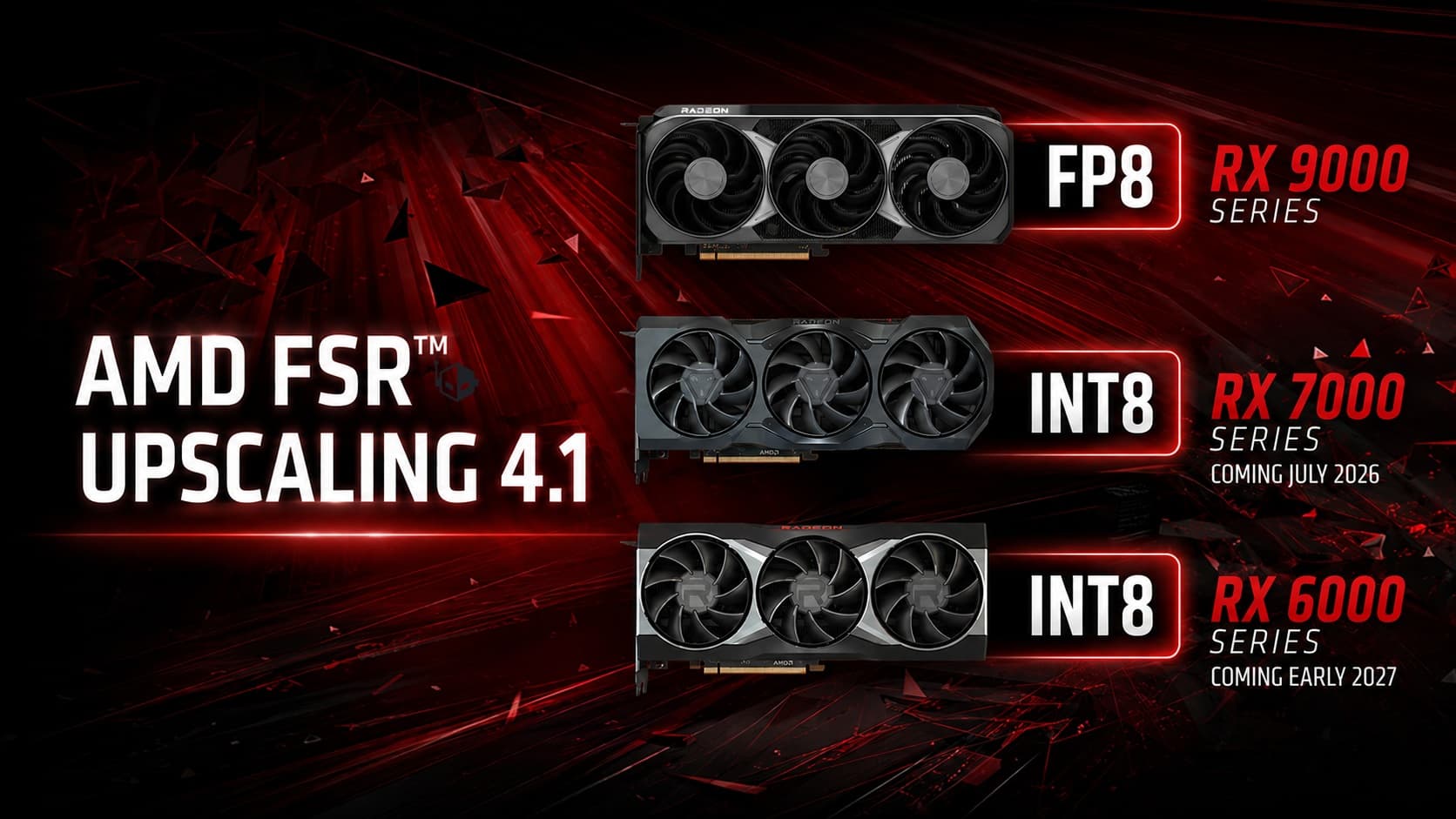
AMD announced that its FSR 4.1 AI upscaling technology will have different models for RDNA 3 and RDNA 2 GPUs due to varying hardware capabilities. RDNA 3 will use a requantized INT8 model instead of FP8, while RDNA 2 requires significant optimization for FSR 4.1 support due to a lack of AI accelerators. This impacts AI upscaling performance and adoption across different GPU generations, with RDNA 2 support delayed until early 2027.

Key Takeaways

  • RDNA 3 GPUs (Radeon RX 7000) will receive FSR 4.1 in July 2026 using a requantized INT8 model instead of the standard FP8.
  • RDNA 2 support (Radeon RX 6000) is scheduled for early 2027 due to the absence of dedicated AI accelerators.
  • AMD targets visual parity between the RDNA 3/2 versions and the high-end RDNA 4 implementation despite architectural differences.
  • The RDNA 2 version must run entirely on general-purpose Stream Processors, requiring extensive shader cycle reduction to maintain performance.

Why It Matters

AMD's strategy to backport AI-driven upscaling to older hardware aims to maintain competitive parity with Nvidia’s DLSS, which has historically offered broader backward compatibility for machine-learning features. By developing custom INT8 and shader-based models, AMD is attempting to prevent ecosystem fragmentation across its installed base of RX 6000 and 7000 series users. This move is critical for retaining market share in the mid-range and handheld segments where RDNA 2 and 3 architectures remain prevalent. Watch for comparative performance benchmarks in July 2026 to see if the INT8 requantization on RDNA 3 incurs a measurable frame-rate penalty compared to native FP8 on RDNA 4 hardware.

Additional Context

The rollout of FSR 4.1 comes as AMD gains significant momentum in the gaming market. Per Digital Foundry (June 2026), AMD's share of graphics cards on the Steam Hardware Survey reached an all-time high of 19.1%, up from 16.4% in early 2025. This growth is driven largely by the value-oriented performance of the RX 7000 and the new RX 9000 series, with the Radeon RX 9070 XT recently charting for the first time. Despite this gain, Nvidia maintains a 72% majority, largely supported by its aggressive deployment of DLSS 4.5 and the newly announced Ray Reconstruction technology, which uses second-generation transformer models to enhance ray-traced image quality (per Nvidia, May 2026). Competition is also intensifying in the handheld sector, where AMD’s RDNA-based APUs have long been dominant. Intel recently challenged this position at Computex 2026 with the debut of the Arc G3 Extreme chip, featured in the $1,699 MSI Claw 8 EX AI+. This hardware supports Intel's XeSS 3 upscaling with Multi-Frame Generation, which Intel claims offers a 44% performance improvement over its previous generation (per TechRadar, June 2026). As AMD's FSR 4.1 arrives on RDNA 3 this July, it will be competing directly with these increasingly sophisticated AI stacks from both Intel and Nvidia. Furthermore, the delay of RDNA 2 support until 2027 highlights the technical debt associated with hardware that lacks dedicated AI silicate. While newer architectures like RDNA 4 and Nvidia’s Blackwell utilize FP8 data types for efficiency, RDNA 3 users must rely on INT8 math, which requires precise conversion to avoid visual artifacts. This software-heavy approach reflects a broader industry trend where GPU manufacturers are using AI to extend the lifecycle of legacy hardware as the costs of new discrete GPUs remain elevated (per Jon Peddie Research, June 2026).


Read full article at wccftech.com

Get this in your inbox → Subscribe

Enjoy our coverage?

Add StreamingMeme as a preferred source on Google to see more of our streaming news at the top of your Search results.

Add as preferred source

Related Articles

MarkTechPost: Induction Labs Photon-1 trains on 18 years of raw video
MarkTechPost: Reactor releases 1.6B parameter open-source Dreamer 4 world-model implementation
Digital Journal: Northwestern’s Spider-Inspired 3D Camera Curbs Machine Vision Power Drain

Newest

1 day ago
Barchart: Cerebras and AMD partner on low-latency AI inference architecture
1 day ago
Light Reading: Charter sidesteps Starlink partnership rumors as Q2 broadband losses widen
1 day ago
GuruFocus: Fastly joins Experian to secure autonomous commerce at the edge
1 day ago
The BIG Newsletter: Nexstar and TEGNA Accused of Violating Judicial Order in $6.2 Billion Merger
1 day ago
AI Rights Brief: Google and Disney integrate AI provenance directly into programmatic ad workflows
1 day ago
Front Office Sports: World Cup afternoon ratings spark shift toward earlier U.S. game windows
1 day ago
Futurism: Meta and TikTok face backlash over deceptive AI-generated health ads
1 day ago
Wccftech: Qualcomm Adreno 850 GPU to debut AI Frame Fusion technology
1 day ago
Beet.TV: Brands must re-describe catalogs for AI agents to maintain discoverability
1 day ago
daily.dev: AVIF achieves universal browser support as Edge and Safari close gaps
1 day ago
Los Angeles Times: Disney, Netflix, and Amazon recruit AI talent to automate production workflows
1 day ago
Callaba: Callaba standardizes remote production workflows via SRT and NDI integration
1 day ago
Lib.rs: New zero-dependency Rust decoder vp9dec achieves bit-exact VP9 conformance
1 day ago
IT Brief UK: Fetch.ai and RedSquid TV launch first agentic AI television platform
1 day ago
Vocal: TeqBlaze challenges Epom with modular full-stack white-label ad tech suite
1 day ago
Euronews: EU Expert Panel Backs Age Restrictions and Addictive Feature Bans
1 day ago
Cord Cutters News: FCC chair signals scrutiny for potential streaming-exclusive 2030 World Cup rights
1 day ago
Audio Chocolate: Merging Technologies debuts Anubis Premium SPS for mission-critical broadcast audio
1 day ago
Cord Cutters News: Linear contraction accelerates as 14 cable networks vanish in five years
1 day ago
IPWatchdog: EC mandates Google share search data and Android features under DMA

Upcoming Events

Jul
29–30
Buffer-Free VideoSeattle
Aug
17–20
SET EXPOSao Paulo
Sep
11–14
IBCAmsterdam
Sep
13
SportsPro Streamtime Sports LiveAmsterdam
Sep
16–18
RTC.ONKrakow
View all events →

Top Sources

  1. 1.Sports Video Group104
  2. 2.SiliconANGLE91
  3. 3.YouTube63
  4. 4.Tech Times60
  5. 5.AdExchanger57
  6. 6.TechCrunch55
  7. 7.arXiv50
  8. 8.PPC Land48
Full leaderboards →

Newest

1 day ago
Barchart: Cerebras and AMD partner on low-latency AI inference architecture
1 day ago
Light Reading: Charter sidesteps Starlink partnership rumors as Q2 broadband losses widen
1 day ago
GuruFocus: Fastly joins Experian to secure autonomous commerce at the edge
1 day ago
The BIG Newsletter: Nexstar and TEGNA Accused of Violating Judicial Order in $6.2 Billion Merger
1 day ago
AI Rights Brief: Google and Disney integrate AI provenance directly into programmatic ad workflows
1 day ago
Front Office Sports: World Cup afternoon ratings spark shift toward earlier U.S. game windows
1 day ago
Futurism: Meta and TikTok face backlash over deceptive AI-generated health ads
1 day ago
Wccftech: Qualcomm Adreno 850 GPU to debut AI Frame Fusion technology
1 day ago
Beet.TV: Brands must re-describe catalogs for AI agents to maintain discoverability
1 day ago
daily.dev: AVIF achieves universal browser support as Edge and Safari close gaps
1 day ago
Los Angeles Times: Disney, Netflix, and Amazon recruit AI talent to automate production workflows
1 day ago
Callaba: Callaba standardizes remote production workflows via SRT and NDI integration
1 day ago
Lib.rs: New zero-dependency Rust decoder vp9dec achieves bit-exact VP9 conformance
1 day ago
IT Brief UK: Fetch.ai and RedSquid TV launch first agentic AI television platform
1 day ago
Vocal: TeqBlaze challenges Epom with modular full-stack white-label ad tech suite
1 day ago
Euronews: EU Expert Panel Backs Age Restrictions and Addictive Feature Bans
1 day ago
Cord Cutters News: FCC chair signals scrutiny for potential streaming-exclusive 2030 World Cup rights
1 day ago
Audio Chocolate: Merging Technologies debuts Anubis Premium SPS for mission-critical broadcast audio
1 day ago
Cord Cutters News: Linear contraction accelerates as 14 cable networks vanish in five years
1 day ago
IPWatchdog: EC mandates Google share search data and Android features under DMA

Upcoming Events

Jul
29–30
Buffer-Free VideoSeattle
Aug
17–20
SET EXPOSao Paulo
Sep
11–14
IBCAmsterdam
Sep
13
SportsPro Streamtime Sports LiveAmsterdam
Sep
16–18
RTC.ONKrakow
View all events →

Top Sources

  1. 1.Sports Video Group104
  2. 2.SiliconANGLE91
  3. 3.YouTube63
  4. 4.Tech Times60
  5. 5.AdExchanger57
  6. 6.TechCrunch55
  7. 7.arXiv50
  8. 8.PPC Land48
Full leaderboards →