StreamingMemeStreamingMemeBuyers Guide
AboutLeaderboardsEventsSubmit News
Subscribe
StreamingMemeStreamingMeme

StreamingMeme is the streaming technology industry news aggregator.

Explore

Buyers GuideLeaderboardsEventsSubmit News

Stay updated

Weekly digest of new companies and streaming news.

Categories

Encoding & SoftwareVideo Delivery & CDNStreaming PlatformsAI for VideoProduction HardwareBusiness NewsMonetization & Ad TechRegulatory & Policy

© 2026 StreamingMeme. All rights reserved.

AboutPrivacy PolicyTermsContact
EncodingCDNPlatformsAI & VideoHardwareBusinessAd TechPolicyIBC Guide
All companies/Encoding & Software
Shaka Player logo
Visit website

Shaka Player

Formats, Codecs & ProtocolsContent Protection & DRM

Website

github.com/shaka-project/shaka-player

Contact

—

Category

Encoding & Software

Type

Vendor

LinkedIn
Updated Aug 24, 2026 ·

Suggest an Edit

Shaka Player

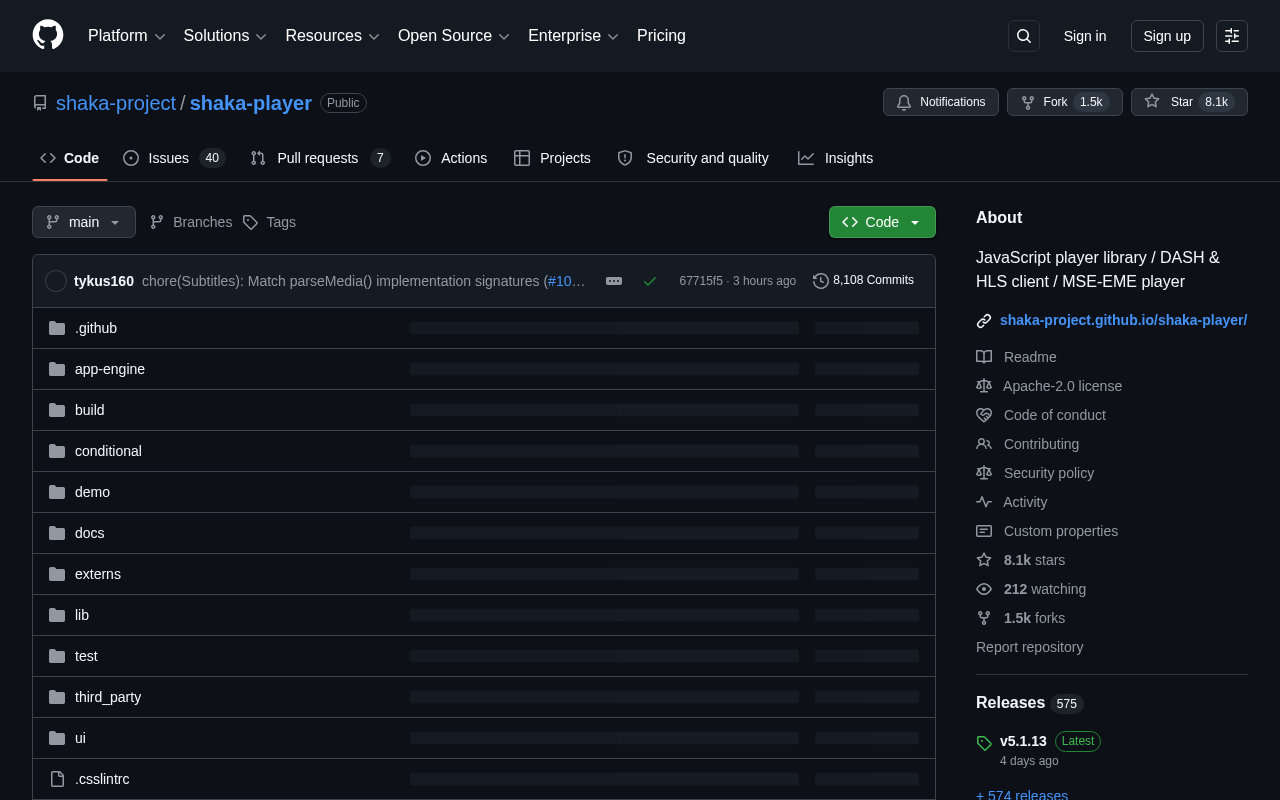
Shaka Player homepage screenshot

Overview

Shaka Player is an open-source JavaScript library that enables adaptive bitrate streaming of DASH, HLS, and MSS formats directly in browsers using MediaSource Extensions and Encrypted Media Extensions, without any plugins or third-party dependencies. It differentiates itself by supporting offline storage and playback via IndexedDB, making it one of the few player libraries to offer robust offline capabilities on any browser. Backed by Google and widely adopted (over 8,000 GitHub stars and 218,000 weekly npm downloads), it provides a lightweight, standards-based solution that integrates seamlessly into web applications.

Products & Services

Shaka Player

Shaka Player is an open-source JavaScript library for adaptive media that plays adaptive media formats (such as DASH and HLS) in a browser, without using plugins or Flash.

Shaka Player in the News

  • Aug 6, 2026
    Encoding
    AWS Elemental MediaTailor adds concurrent function execution to cut pipeline latency

    AWS has updated its SDK to include concurrent function execution for Elemental MediaTailor, enabling parallel child function runs to improve latency in streaming pipelines. The update also adds support for various new features across other AWS services, including S3 access points for AWS Backup and updated controls for Amazon Bedrock AgentCore.

  • Jul 31, 2026
    Encoding
    AWS updates Go SDK with Elemental Inference graphic composition features

    AWS has updated its Go SDK to version 2026-07-31.2, which includes new graphic composition capabilities for AWS Elemental Inference on cropped video outputs. The release also introduces transcript formatting improvements for Amazon Transcribe and mid-conversation tool change support for Amazon Bedrock.

  • Jul 28, 2026
    Encoding
    MediaMTX regression breaks AV1 RTMP-to-RTSP ingestion since version 1.16.0

    A regression in MediaMTX v1.16.0 causes AV1 video ingested over RTMP to become undecodable when delivered via RTSP, while HLS delivery remains unaffected. The issue, linked to code changes in the internal codec processor, has been verified across multiple subsequent versions using FFmpeg and other publishers.

  • Jul 23, 2026
    Platforms
    Apache APISIX enables keyless Vertex AI authentication for streaming infrastructure

    Apache APISIX is adding GCP Workload Identity support to its ai-proxy plugin, allowing developers to authenticate with Vertex AI services keylessly. This update removes the need for managing static service account keys when deploying streaming infrastructure on Google Kubernetes Engine.

  • Jul 19, 2026
    Encoding
    QSVEnc updates enable NPU-accelerated video filtering and SDR-to-HDR conversion

    Rigaya has updated its QSVEnc encoding tool to versions 8.21 and 8.22, adding support for Windows named pipes and multi-threaded OpenCL pipeline optimizations. The updates also expand video processing capabilities with new RIFE frame interpolation filters, ONNX-based NPU processing, and additional SDR to HDR model support.

  • Jun 29, 2026
    Shaka Player v5.1.12 released

    GitHub shows Shaka Player’s latest release as v5.1.12, published on June 29, 2026. This is a company-specific project release within the requested 7-day window.


  • Jun 18, 2026
    Encoding
    Eyevinn Technology launches Strom open-source GStreamer engine for visual workflows

    Eyevinn Technology has released Strom, an open-source GStreamer media pipeline engine with a browser-based node editor for real-time video flows. The system supports WebRTC, SRT, NDI, and AES67, and acts as the media backend for the Open Live production platform.

  • Jun 17, 2026
    Platforms
    New Chrome extension provides real-time video quality metrics for Paramount+

    A new Chrome extension, ParamountQuality+, provides real-time streaming quality insights for Paramount+ content, including resolution, bitrate, and manifest data. This tool is designed to offer engineers and analysts direct access to in-browser video playback metrics for VOD and live streams. It injects lightweight instrumentation to inspect manifests and segments, supporting MPEG-DASH and HLS formats for both on-demand and Google DAI live streams.

  • Jun 16, 2026
    AI & Video
    WhisperSubs brings local AI-powered subtitle generation to Jellyfin servers

    GeiserX has developed WhisperSubs, a Jellyfin plugin that automatically generates subtitles for media libraries using local AI models. The plugin supports fully local audio transcription via whisper.cpp, automatic language detection, forced subtitles, and GPU acceleration. It includes features like a priority queue, real-time progress updates, and scheduled tasks for seamless integration with Jellyfin's admin UI.

  • Jun 12, 2026
    AI & Video
    Lightricks LTX-2 optimization enables 4K AI video on consumer GPUs

    This GitHub repository provides a curated list of models, text encoders, and tools for the LTX-2 video generation suite, highlighting LTX2.3-Multifunctional, a desktop-optimized version with lower GPU requirements (24GB VRAM). It details various LTX-2 models, including quantized versions, LoRAs, and specialized text encoders designed to enhance generative AI capabilities for video production by improving prompt adherence and fidelity.

Visit website