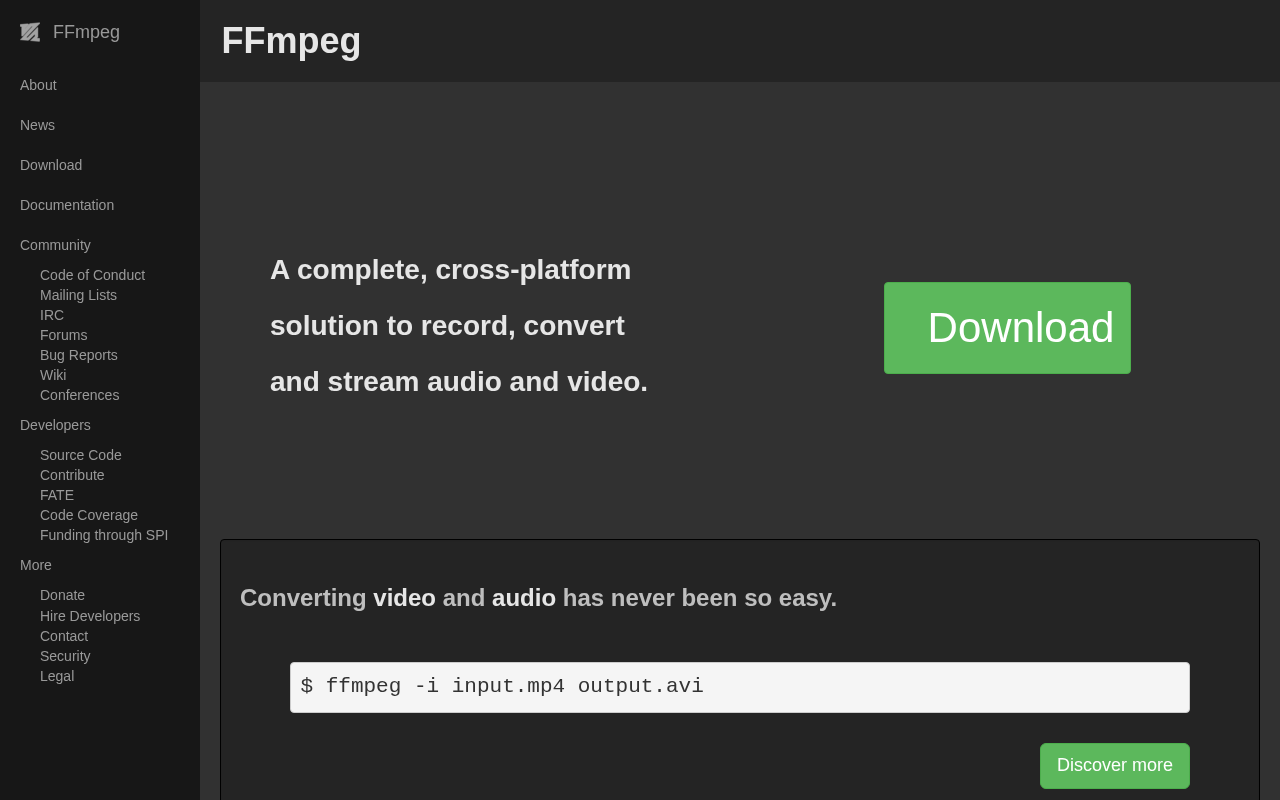
FFmpeg is a comprehensive, cross-platform open-source multimedia framework that provides a collection of libraries and tools for recording, converting, and streaming audio and video. Its core libraries (libavcodec, libavformat, libavfilter, etc.) support an extensive range of codecs, formats, and protocols, making it a versatile foundation for multimedia processing. Unlike proprietary solutions, FFmpeg is community-driven with a transparent governance model featuring a General Assembly and Technical Committee, and it offers consulting services from core maintainers for customization and support. Its widespread adoption across industries underscores its reliability and innovation in handling complex multimedia workflows.
FFmpeg documentation details the implementation of libavfilter for constructing complex multi-input, multi-output video processing filtergraphs. It describes filtergraph syntax, chaining, and the use of graph2dot for visualization. This documentation is foundational for developers building encoding and video processing pipelines.
FFmpeg has released version 8.1.2 of its open-source multimedia framework, making the source code available for download. The release includes links to partner-provided pre-compiled binaries for Linux, Windows, and macOS, as well as instructions for PGP cryptographic verification.
This article details FFplay, a media player built using FFmpeg and SDL libraries, outlining its command-line options and functionalities. It serves as a testbed for FFmpeg APIs, providing crucial specifications for developers and engineers working with media handling and testing. The documentation covers aspects like stream specifiers, generic options, AVOptions, and operational commands while playing.
FFmpeg has released documentation for ffplay, a simple media player built using FFmpeg libraries and SDL. Primarily used as a testbed for FFmpeg APIs, the guide offers detailed information on options, stream specifiers, and advanced playback features. This resource is crucial for developers and engineers working with FFmpeg tools.
This article details the comprehensive list of input and output protocols supported by FFmpeg's libavformat library, including AMQP, HTTP, RTMP, SRT, and more. It outlines the syntax and available options for each protocol, which are critical for developers building robust streaming applications using FFmpeg. The documentation serves as a technical reference for configuring FFmpeg builds and tools for various streaming transport mechanisms.
The provided article is the official documentation for FFmpeg, an open-source project that consists of a vast suite of libraries and programs for handling video, audio, and other multimedia files and streams. It details FFmpeg's capabilities, command-line usage, and various components for transcoding, streaming, and playing multimedia content. The document serves as a comprehensive reference guide to the software's functionalities and options.


