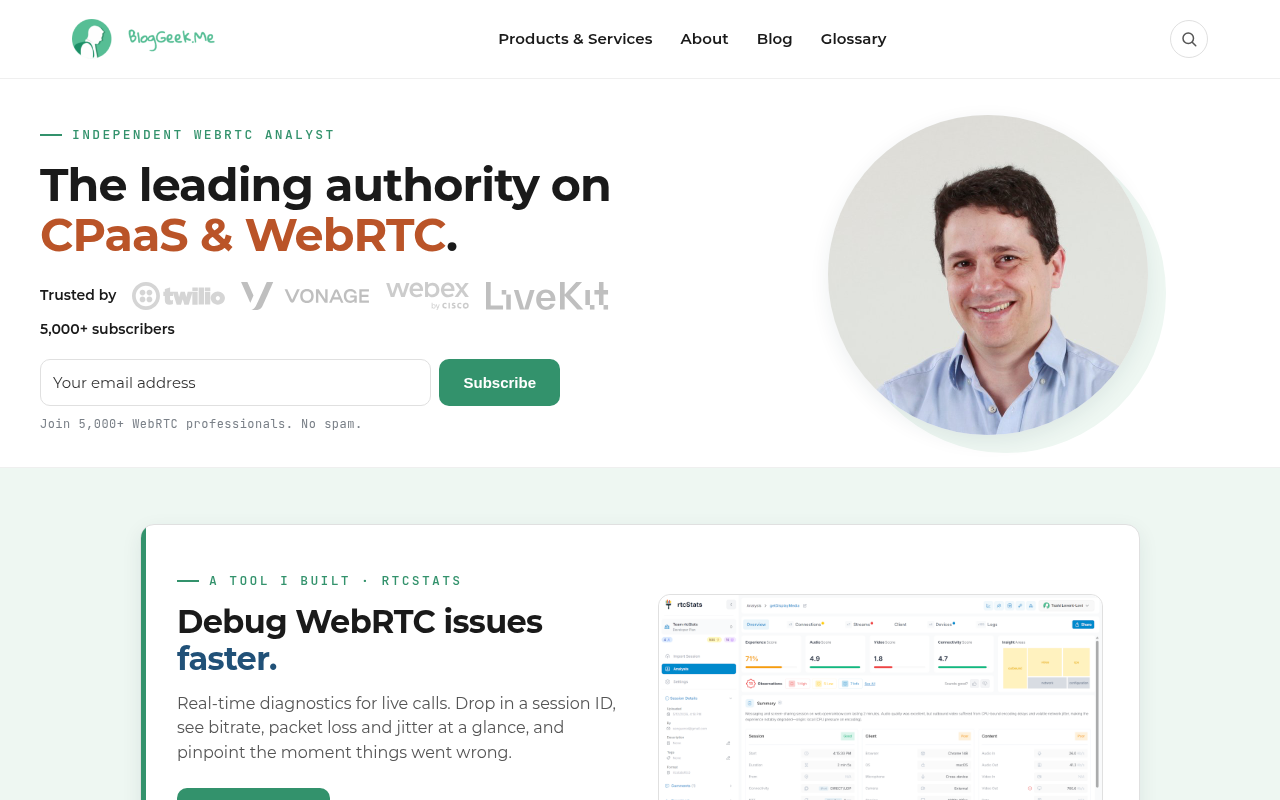
BlogGeek.me is a leading independent authority on WebRTC and CPaaS, offering consulting, training, and analytics tools. It differentiates itself through deep technical expertise and a newsletter trusted by 5,000+ subscribers. The company's rtcStats tool provides open-source WebRTC analytics, and its online courses have trained over 1,800 students across 100+ countries. Consulting engagements help companies solve complex WebRTC issues.
A tool to debug WebRTC issues faster with real-time diagnostics for live calls.
A free 60-page primer on what WebRTC is, who uses it, and where the market is going.
A free eBook on the metrics that actually matter for measuring real-world call quality.
WebRTC adoption in Chrome has reached 0.3% of page loads, indicating a post-pandemic recovery in usage despite a decline in community discussion and standardization activity. The protocol remains in a mature maintenance phase, with Google serving as the primary driver of ongoing development.
An analysis of the WebRTC open source media server landscape as of September 2026 highlights Jitsi Meet, LiveKit, and Pion as the leading projects by GitHub popularity. The report evaluates these tools based on commit activity and contributor distribution, noting that project selection should be driven by specific use cases like conferencing, programmable backends, or streaming.
A free mini email course on signaling, ICE, and getting peers reliably connected.
The Media over QUIC (MOQ) protocol is currently in draft form and lacks the comprehensive media engine features, such as congestion control, that are natively provided by WebRTC. Because MOQ is designed to be transport-agnostic, developers must implement complex media logic themselves, creating significant barriers for teams without specialized streaming expertise.
This article explains Scalable Video Coding (SVC) as a technique to enhance WebRTC by enabling single-stream, multi-layered video encoding, which improves efficiency over simulcast in large video conferences and diverse network conditions. It details how SVC works, its modalities (temporal, SNR, spatial scalability), and provides a comparison with simulcast, along with guidance on when to use each and how to enable SVC in WebRTC for VP9.
This article explains STUN (Session Traversal Utilities for NAT), a lightweight client-server protocol defined in IETF RFC 5389. STUN enables devices behind Network Address Translators (NAT) to discover their public IP address and port, playing a key role in WebRTC's NAT traversal mechanisms alongside TURN and ICE. It outlines the function of a STUN server and best practices for its deployment, often in conjunction with TURN.
This article explains Variable Bit Rate (VBR) encoding, detailing how it adjusts bit allocation based on content complexity to improve quality for VOD and stored media. It contrasts VBR with Constant Bit Rate (CBR) and clarifies why VBR is typically used for on-demand content and pre-recorded streaming, while CBR is preferred for real-time applications like WebRTC due to VBR's unpredictable short-term bitrate spikes.
This article provides an overview of VP8, Google's open-sourced, royalty-free video codec, highlighting its historical significance as the mandatory-to-implement codec for WebRTC. It details VP8's role in ensuring universal browser compatibility and its technical workings, comparing it to other modern codecs like H.264, VP9, and AV1. The piece emphasizes VP8's continued use as a fallback codec despite newer, more efficient alternatives.


