

RISC-V captures 25% market share as Google mandates 64-bit TV support
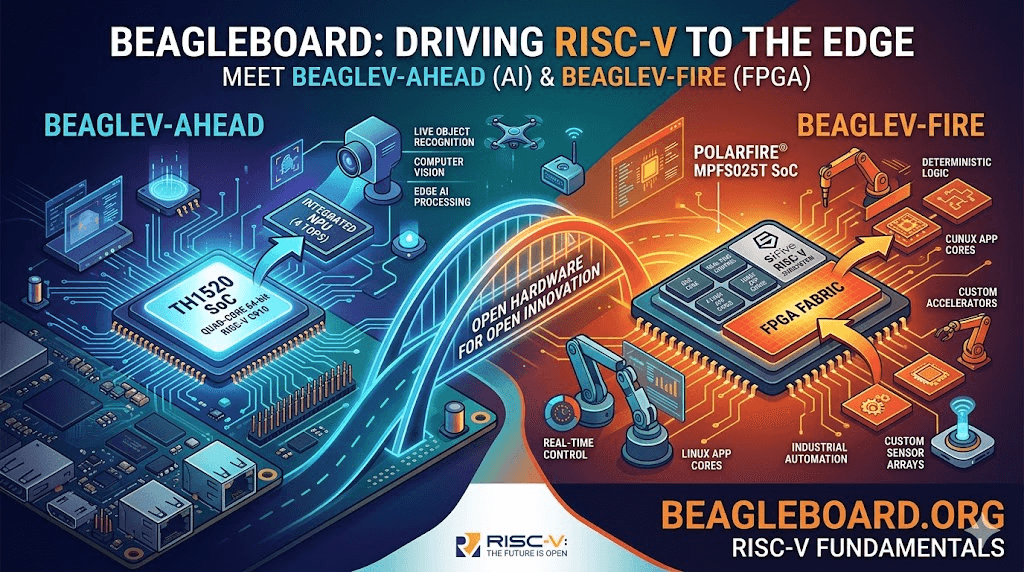
The article details how RISC-V, an open-source instruction set architecture, is becoming foundational for 'AI-native' hardware at the edge, enabling custom silicon design for AI workloads. This technology reduces latency and power consumption by allowing co-design of hardware and AI software, leading to more efficient AI in various devices. Companies like Google, Bosch, and Infineon are adopting RISC-V for applications ranging from consumer electronics to automotive systems, including those relevant to video decoding and processing.
Key Takeaways
- RISC-V reached 25% global market penetration by early 2026, officially becoming the 'third pillar' of compute alongside x86 and ARM.
- Google TV and Android TV will require all apps to provide 64-bit support starting August 1, 2026, favoring high-performance RISC-V extensions.
- Qualcomm fully transitioned its Snapdragon Wear platform to RISC-V in 2026 to avoid 'ARM tax' royalties and enable custom AI instructions.
- SiFive and NVIDIA integrated NVLink Fusion into RISC-V platforms, allowing open-source CPUs to communicate directly with CUDA-X software stacks.
- Andes Technology launched the AX46MPV core as a drop-in replacement for the ARM Cortex-A55, claiming superior performance-per-watt for edge devices.
Why It Matters
The transition to RISC-V represents a fundamental move from generic proprietary silicon to workload-specific architecture. For streaming, this enables hardware-software co-design where video decoding and AI-driven upscaling instructions are baked directly into the silicon, drastically reducing heat and power in sticks and smart TVs. As Google mandates 64-bit 16KB page size support for TV apps, the standard shifts toward the high-performance RVA23 profile. This breaks the ARM licensing monopoly, allowing device manufacturers to reinvest royalty savings into specialized media accelerators. Watch for the first flagship RISC-V-native streaming boxes to hit retail in late 2026 as the Android TV 64-bit deadline nears.
Additional Context
The commercial viability of RISC-V in the consumer media segment has accelerated significantly following major ecosystem alignment. Per a June 2026 report from SNS Insider, the RISC-V market is projected to reach $25.07 billion by 2035, with the consumer electronics segment currently leading adoption at a 34% share. This growth is underpinned by the ratification of the RVA23 profile, which provides the standardized instruction set required for mainstream operating systems like Android and enterprise Linux to achieve performance parity with ARM-based incumbents.
Technological barriers have also fallen through high-profile partnerships between open-source proponents and legacy giants. In May 2026, SiFive launched its Performance P570 Gen 3 core featuring out-of-order superscalar vector units specifically designed to handle localized AI inference in wearables and smart home interfaces. Simultaneously, NVIDIA's decision to port its CUDA-X stack to RISC-V has bridged the gap between custom open-source logic and established AI development frameworks, effectively removing the software 'moat' that previously protected proprietary architectures.
In the automotive and industrial sectors, standardized platforms are maturing to support media-heavy workloads. Per Quintauris (March 2026), the launch of the RT-Europa reference architecture has provided a gold standard for real-time RISC-V processors. This platform is now being used by major vendors like Infineon and Bosch to handle everything from safety-critical braking systems to ADAS perception tasks, proving that RISC-V can meet the stringent reliability and latency requirements formerly reserved for high-cost proprietary silicon.
Read full article at automatedbuildings.com
Enjoy our coverage?
Add StreamingMeme as a preferred source on Google to see more of our streaming news at the top of your Search results.
Add as preferred source