
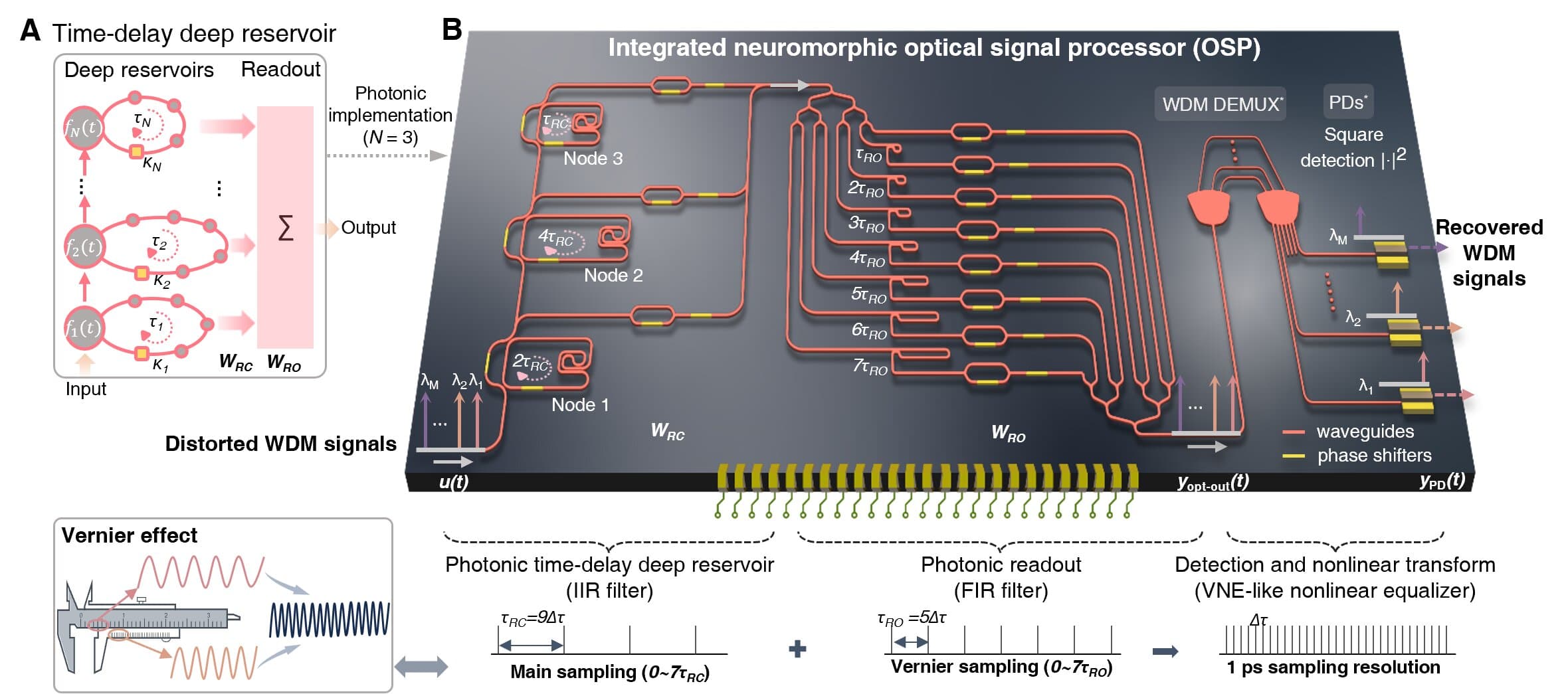
Researchers at The Chinese University of Hong Kong (CUHK) have developed an integrated all-optical signal processor (OSP) that achieves 1.6 Tb/s real-time processing with extremely low latency and energy consumption. This innovation directly addresses data transmission bottlenecks in AI data centers by processing signals in the optical domain, bypassing conventional electrical conversion for greater efficiency. The OSP is designed to improve communication efficiency between servers and data centers, crucial for large-scale AI systems.
The transition to all-optical processing eliminates the 'electrical bottleneck,' where repeated conversions between light and electricity drive significant latency and heat in AI clusters. This OSP architecture allows data to remain in the optical field throughout the equalization process, a critical requirement for maintaining 1.6 Tb/s throughput in distributed AI training environments. For the ecosystem, this move validates all-optical architectures as a viable successor to traditional digital signal processing (DSP) in the next phase of high-speed networking. Watch for the integration of these OSPs into commercial silicon photonic transceivers, particularly those targeting the 200G per lane standard.
CUHK's all-optical signal processor represents a significant advance in silicon photonics for data center networking. The research team, led by Professor Huang Chaoran from the Department of Electronic Engineering, collaborated with researchers from Huazhong University of Science and Technology (HUST) and Fudan University (FDU) to develop the programmable OSP architecture. The OSP employs a deep optical reservoir with an all-optical readout that achieves effective sampling resolution down to 1 picosecond, using intentionally detuned sampling periods to create a Vernier-like effect that provides a long, tunable memory window for signal processing.
The CUHK team published its findings in the journal Science, positioning the OSP as a programmable nonlinear equaliser capable of compensating chromatic dispersion, transceiver bandwidth limitations, and fiber nonlinearities. The system demonstrated the potential to expand usable wavelength-division multiplexing bandwidth by a factor of 6.8, which would significantly increase per-fiber transmission capacity and shoreline density in data center environments. The OSP's programmability allows dynamic adaptation to different wavelengths, data rates, and modulation formats without hardware changes.
The OSP architecture processes eight wavelength channels simultaneously at 100 Gbaud PAM4, with each channel delivering approximately 200 Gbit/s. The processing latency of below 60 picoseconds is shorter than a single clock cycle in many digital systems, while energy consumption remains at tens of femtojoules per bit. These metrics position the technology as a potential replacement for conventional digital signal processing in short-reach data center interconnects, where DSP-based equalization increasingly struggles to meet the speed, latency, and power constraints of 200G-per-lane transmission standards.
Add StreamingMeme as a preferred source on Google to see more of our streaming news at the top of your Search results.
Add as preferred source