

NVIDIA GB300 rack delivers 20x higher agentic coding performance vs H200
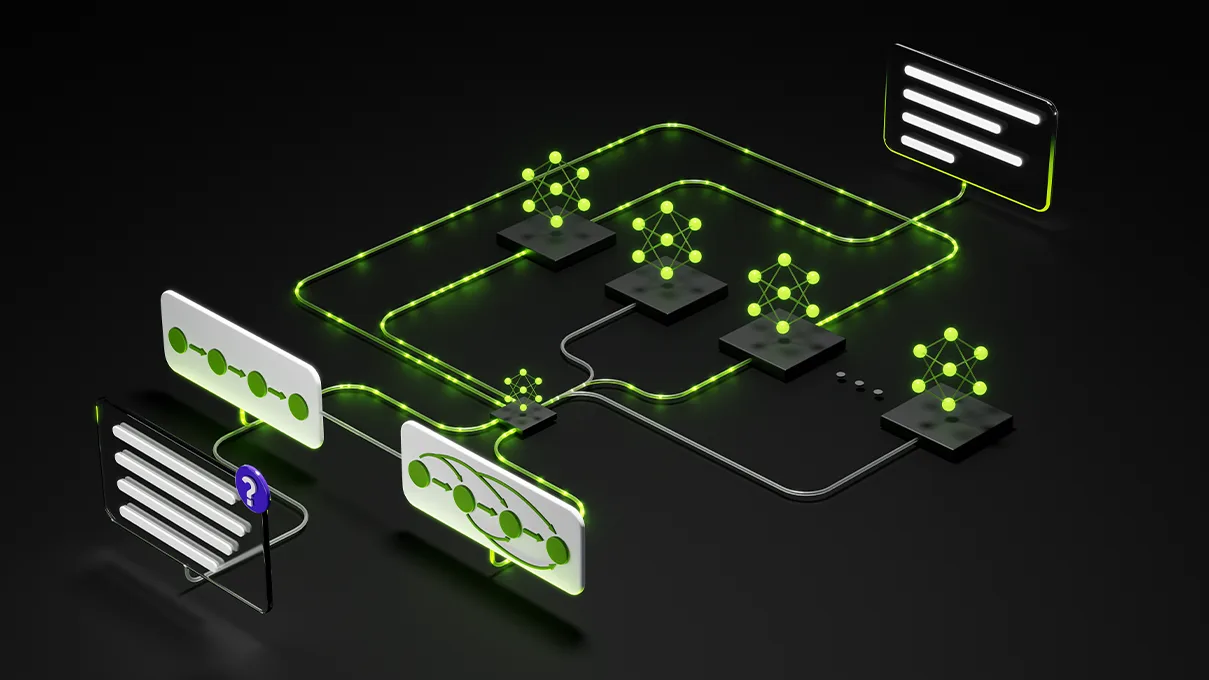
NVIDIA's GB300 NVL72 product achieved up to 20x higher agentic coding performance than its predecessor, the H200, in the new AA-AgentPerf benchmark from Artificial Analysis. This benchmark measures concurrent AI agents per megawatt and per GPU for agentic workloads. This advance in large-scale AI processing could have implications for future video streaming applications.
Key Takeaways
- GB300 NVL72 supports 61,400 concurrent agents per megawatt, up from 2,600 on the H200 platform.
- The AgentPerf benchmark used the 1.6-trillion parameter DeepSeek-V4-Pro Mixture-of-Experts (MoE) model to simulate real-world coding sequences.
- Hardware efficiency reached 57.5 agents per GPU on the Blackwell Ultra system, compared to 1.4 on the previous generation.
- Upcoming Vera Rubin GPUs are projected to hit 50 PFLOPs of NVFP4 inference compute, a 5x increase over early Blackwell designs.
Why It Matters
The shift from single-turn chatbots to autonomous agents exponentially increases inference demand, making energy efficiency the industry's primary scaling constraint. NVIDIA's 20x density gain suggests that streaming-adjacent workflows—such as real-time metabolic monitoring for automated QC or agentic metadata generation—can scale without traditional power-grid bottlenecks. For the streaming ecosystem, this indicates a pivot where compute costs are dictated by task completion speed in reinforcement-learning loops rather than raw token throughput. Watch for the first large-scale deployments at Microsoft Azure and CoreWeave as a signal for the viability of autonomous agents in production video pipelines.
Additional Context
The launch of the AA-AgentPerf benchmark in March 2026 arrived as data center operators faced unprecedented power constraints, with electricity costs emerging as the binding limit on AI growth. Per CryptoBriefing (June 2026), NVIDIA's GB300 NVL72 architecture addresses this via 'extreme co-design,' integrating 72 Blackwell Ultra GPUs and 36 Grace CPUs into a single liquid-cooled rack. This configuration delivers roughly 130 TB/s of NVLink bandwidth, a critical requirement for serving Mixture-of-Experts (MoE) models like DeepSeek-V4-Pro, which DeepSeek released in April 2026 under the MIT license. DeepSeek's V4 series has already demonstrated high efficiency, requiring only 10% of the KV cache used by its predecessors for million-token context windows, according to DeepInfra (April 2026).
While NVIDIA leads in agentic density per megawatt, competitors are challenging its architectural thesis. At Computex in June 2026, Intel and AMD both argued that agentic orchestration is becoming a CPU-bound problem. Per Futurum Group (June 2026), Intel’s liquid-cooled Xeon 6+ racks are targeting up to 150,000 agents per rack by optimizing for orchestration density over raw reasoning speed. Simultaneously, AMD claimed that its upcoming 'Venice' EPYC processors could deliver 3.30x the rack-level CPU throughput of NVIDIA’s Vera baseline, per AMD (June 2026). This divergence suggests a bifurcated market: NVIDIA leads on task-completion speed in GPU-heavy reinforcement-learning sandboxes, while Intel and AMD fight for the 'agentic head-node' market, where tool-calls and orchestration consume the majority of end-to-end latency.
Read full article at developer.nvidia.com
Enjoy our coverage?
Add StreamingMeme as a preferred source on Google to see more of our streaming news at the top of your Search results.
Add as preferred source