
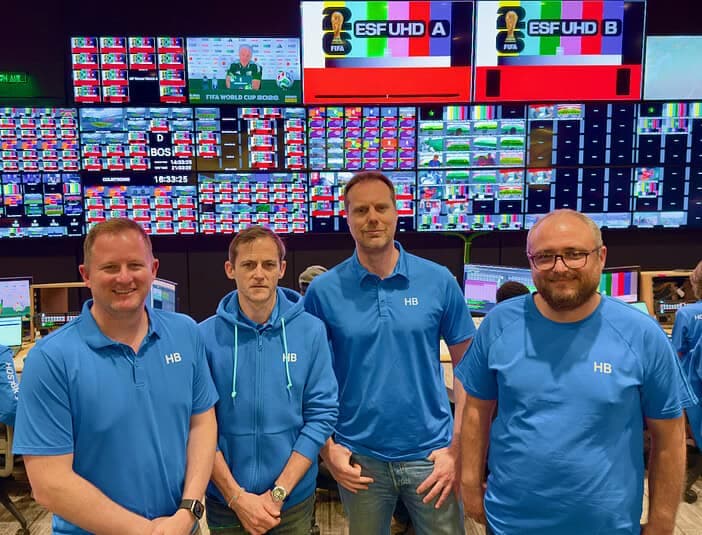
Host Broadcast Services (HBS) is implementing a decentralized production model for the 2026 FIFA World Cup, spanning 16 venues across the US, Mexico, and Canada. This approach heavily relies on software-based processing, a converged ST-2110 network, and a private cloud infrastructure to efficiently deliver 104 matches in UHD HDR. Centralized replay, audio mixing, graphics, and shading operations are being handled from the IBC in Dallas.
This shift marks the transition of remote production from a cost-saving experiment to the core operational standard for global-scale sporting events. By decoupling human expertise from physical venues, HBS solves the talent scarcity issue inherent in managing 104 matches across 16 cities. The move to software-defined processing on COTS hardware signals the end of reliance on bespoke broadcast machinery for primary workflows. For the broader ecosystem, this validates high-bandwidth ST-2110 and JPEG-XS at unprecedented scale, proving that uncompressed or lightly compressed IP transport can maintain UHD HDR quality across continental distances. Watch for whether this decentralized model becomes the template for the 2028 Olympics and upcoming regional football championships.
HBS's decentralized model for the 2026 FIFA World Cup builds directly on lessons from the 2022 tournament in Qatar, where the company first moved to an IP-based production workflow. HBS CEO Dan Miodownik and CTO Christian Gobbel described the 2022 Qatar World Cup as the first to use IP as the primary production standard, with remote-controlled cameras operated from the IBC and multi-feed galleries centralized rather than deployed at each venue. Gobbel specifically noted that the future model would involve deploying only cameras at venues, compressing signals, and centralizing shaders and virtualized galleries at a single hub, a vision now realized at scale across 16 cities in three countries.
For the 2026 tournament, HBS has confirmed that JPEG XS serves as the compression backbone of its ST 2110 network connecting all venues to the Dallas IBC. Christophe Barbe, head of broadcast infrastructure at HBS, told TVBEurope that the technology was trialed during the FIFA Club World Cup, with end-to-end workflows tested at the two stadiums furthest from the New Jersey base to verify latency thresholds. Etienne Godart, head of live broadcast solutions at HBS, confirmed that all central operations including shading and replay are based in Dallas with remote connectivity to stadiums, while post-production is handled from London via a dedicated JPEG XS link. HBS is working with Verizon, FIFA's official telecommunications provider, to establish the underlying network.
The JPEG XS and ST 2110 transport layer that HBS relies on has been validated in other large-scale sports deployments using Nevion's Virtuoso platform. Nevion enhanced Virtuoso with JPEG XS in transport streams and WAN capabilities in March 2023, adding VSF TR-07 compliance alongside the existing VSF TR-08 JPEG XS in ST 2110 support. The platform has been used for high-profile sports events globally, and Viacom18 deployed Nevion Virtuoso for the TATA IPL in 2023, connecting 12 stadiums to three studio locations over distances up to 2,000 km using JPEG XS and JPEG 2000 compression for HD and UHD feeds. These deployments confirm that JPEG XS over WAN can maintain broadcast-quality video at the distances and scale HBS requires for the 2026 World Cup.
Add StreamingMeme as a preferred source on Google to see more of our streaming news at the top of your Search results.
Add as preferred source