

Agora launches translation beta with sub-second latency for live streaming
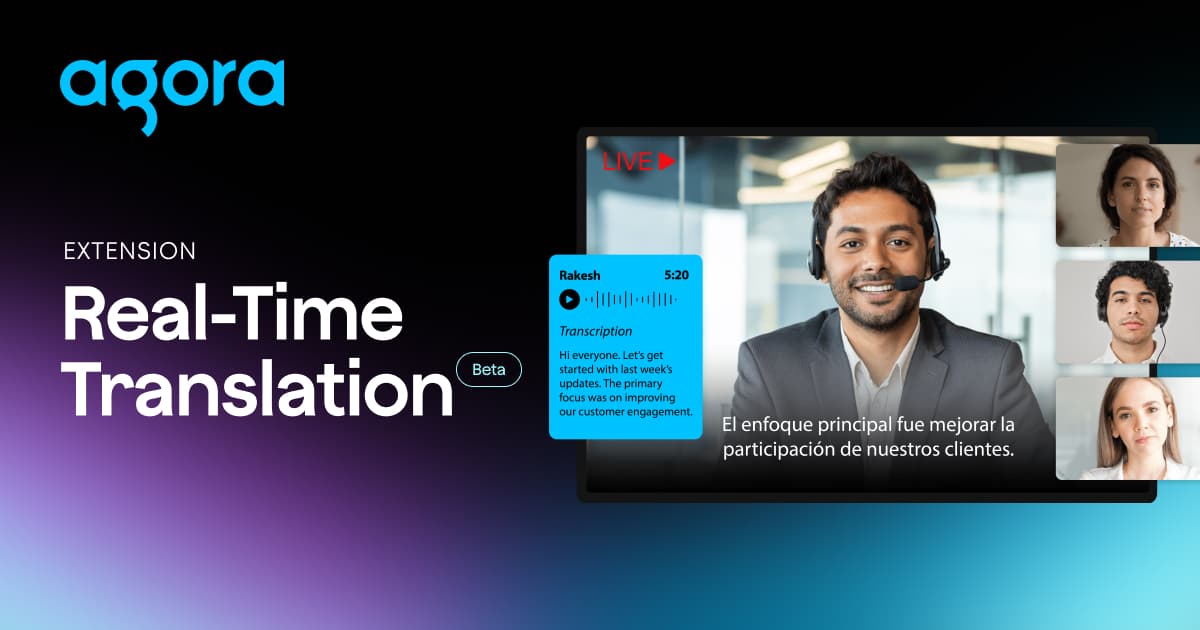
Agora has launched a beta for its Real-Time Translation service, offering live speech-to-text translation for up to four source languages into ten target languages, with ultra-low latency. This new offering also integrates with Large Language Models (LLMs) and provides AI-powered noise suppression, enhancing real-time communication for various applications. The Real-Time Translation beta is part of Agora's broader conversational AI engine, designed to break down language barriers in live voice and video communication across a range of platforms and devices, supported by flexible SDKs and APIs.
Key Takeaways
- Average end-to-end translation latency is rated under 3 seconds to preserve natural conversation flow in live video sessions.
- The service supports over 30 languages, allowing up to ten concurrent localized caption tracks per audio source.
- Direct Large Language Model (LLM) integration allows developers to use custom models for context-aware refinements or post-processing.
- Cloud-based storage captures Video Text Track (VTT) files for searchability, post-event AI analysis, and regulatory compliance.
- The translation extension is manageable via the Agora Console and supports mobile, web, and IoT hardware via the Riselink alliance.
Why It Matters
The launch addresses the technical bottleneck of latency in multilingual live engagement, moving closer to 'instant' localizations required for high-stakes interactive video. For the streaming ecosystem, it signals a shift where real-time accessibility is an infrastructure feature rather than an expensive post-production add-on. Competitively, Agora’s integration with OpenAI's Realtime API provides a turnkey path for developers to deploy voice agents that bypass the 'record-transcribe-process-reply' loop. Watch for the adoption rate in virtual events and education markets, where the 80% cost reduction over traditional interpretation hardware could trigger a shift away from human-only interpretation models.
Additional Context
The global AI video translation market is undergoing significant expansion, with projections from Dimension Market Research in June 2026 estimating the sector will reach $5.04 billion by the end of 2025. This growth is driven by the scaling of automated localization across OTT platforms like Netflix and YouTube, which are increasingly using generative AI to reduce dubbing and subtitling turnaround times by nearly 70%. Per Yahoo Finance, June 2026, enterprise adoption of hardware-free translation is also accelerating, with over 90% of hybrid events expected to utilize cloud-based live captioning by year-end.
Agora's move follows a series of technical milestones for the company, including the launch of its Conversational AI Engine in early 2025, which claimed to deliver voice responses 3x faster than standard LLM voice modes. According to Investing.com, September 2025, Agora has deepened its partnership with OpenAI to incorporate 'Selective Attention Locking,' a proprietary technology that filters ambient noise to ensure AI agents can focus on a single speaker in crowded environments. This development aligns with a broader industry trend toward multimodal interaction, as noted by FutureCIO in June 2026, where platforms are unifying voice, text, and visual AI avatars into single-session workflows.
At the hardware layer, Agora’s collaboration with Riselink and the deployment of the ConvoAI Device Kit targets the burgeoning interactive toy and robotics sector. Per company reports from October 2024, IoT manufacturers like Wyze are already leveraging these SDKs to integrate natural voice interfaces into smart home devices. Market analysts from Mordor Intelligence suggest the machine translation market will hit $1.34 billion in 2026, fueled largely by these embedded AI applications that require low-latency audio processing on edge devices.
Read full article at prod.agora.io
Enjoy our coverage?
Add StreamingMeme as a preferred source on Google to see more of our streaming news at the top of your Search results.
Add as preferred source