

Adobe brings conversational AI Assistant to Premiere and Frame.io beta
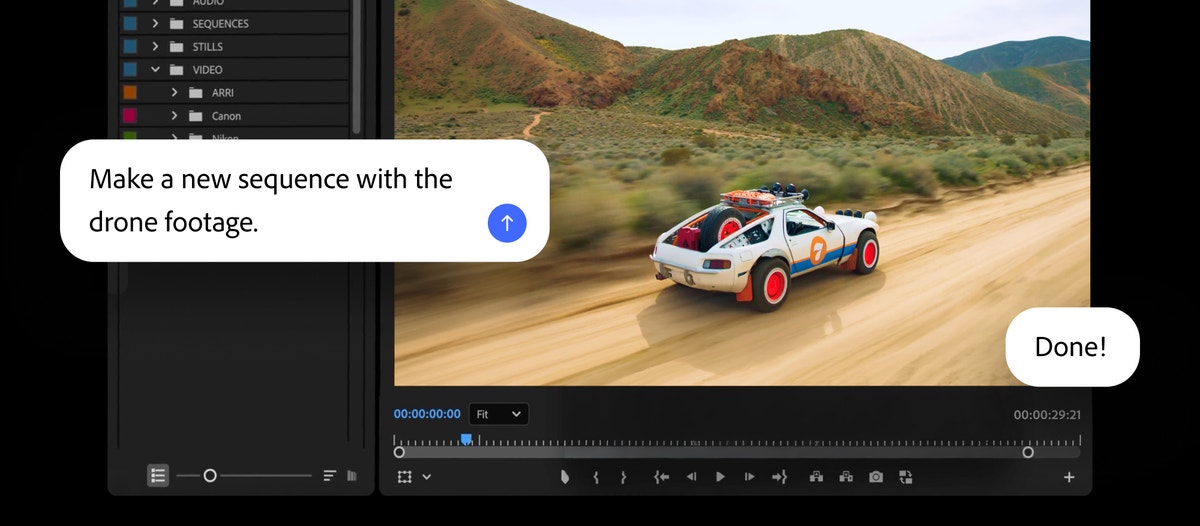
Adobe has announced the integration of its generative AI Assistant into Creative Cloud applications, including Premiere, Photoshop, and Frame.io, to automate repetitive, multi-step production tasks. For video workflows, the assistant can automate asset organization, batch-rename clips, track feedback, and generate B-roll. The AI Assistant features are currently available in public beta, with After Effects in private beta.
Key Takeaways
- Premiere users can now use AI to automate bin sorting, batch rename clips, and assemble initial timeline drafts from source media.
- Frame.io integration enables the assistant to organize assets, track feedback across revisions, and generate B-roll within the workspace.
- After Effects has entered a private beta phase for the AI Assistant, joining general public betas for Premiere and Photoshop.
- The system uses an underlying "creative agent" capable of executing multi-step workflows while keeping human editors in control of final outputs.
Why It Matters
The shift toward agentic AI marks a move from single-task tools to autonomous workflow orchestration within the post-production stack. By automating low-level asset management and rote organization, Adobe is attempting to defend its professional footprint against AI-native upstarts that prioritize speed over precision. For the broader ecosystem, this signals a consolidation of generative capabilities directly into the NLE timeline, reducing the need for disjointed third-party plugins. Media executives should watch for a potential shift in production budgets toward high-volume content variants, as these tools lower the cost of iterative versioning. Tracking the conversion from public beta to general availability will be critical for assessing wide-scale enterprise adoption.
Additional Context
The rollout follows a period of intense pressure for Adobe as competitors like OpenAI's Sora and Runway have rapidly iterated on high-fidelity generative video. Per Adobe, June 2026, the company is also expanding its ecosystem by planning integrations for Google Gemini and Slack, ensuring its AI agents can operate across third-party communication and model platforms. This strategy mirrors moves by Blackmagic Design, which released DaVinci Resolve 21 in June 2026 with its own suite of Neural Engine-powered tools for tracking and audio isolation, according to PRNewswire, June 2026. Financial analysts have voiced a mix of caution and optimism regarding Adobe's AI pivot. Per Investing.com, June 2026, UBS recently lowered its price target for Adobe to $225, citing concerns over pricing power despite the company's 89% gross profit margins. Meanwhile, internal Adobe research involving 16,000 creators indicates that 75% of professionals now view generative AI as essential to their work, though 85% insist that final creative decisions must remain manual. This data likely informed Adobe's "agentic" approach, which focuses on assistance rather than replacement. Technically, these new assistants represent an evolution of the Firefly Video Model. Per Adobe's April 2025 announcement at NAB, the core model graduated to general availability with support for 4K and vertical video generation. By June 2026, these capabilities have been refined into the "AI Assistant" interface, which allows for conversational interaction. This aligns with broader market trends where tools like Luma Labs’ Ray and Google’s Veo 3 have transitioned from research demos to production-ready API services during the first half of 2026.
Read full article at blog.adobe.com