

CUTZ's ML-powered encoding reduces video bitrate by 70% for CSRD compliance
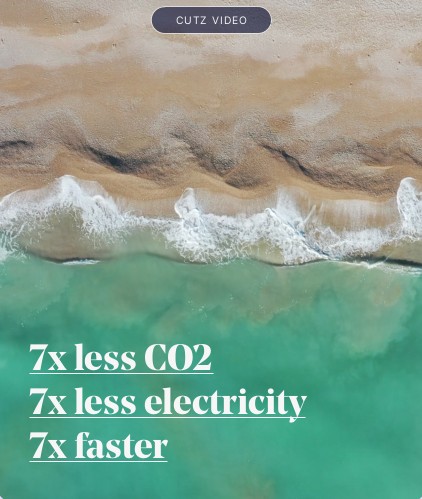
CUTZ offers an ML-powered video encoding solution designed to reduce video file sizes and energy consumption while maintaining high visual quality (guaranteeing VMAF scores above 95). The solution aims to help businesses achieve 'digital sobriety,' comply with regulations like CSRD, and improve delivery performance by reducing bandwidth usage and increasing engagement through faster loading times. It integrates via a SaaS platform or codec-agnostic API, providing a full report on estimated gains to prove ROI.
Key Takeaways
- Reduces video file size from 11.5 MB to 3.5 MB in production tests, a nearly 70% reduction in data volume.
- Guarantees perceptual visual quality with VMAF scores consistently above 95 through ML-driven bit allocation.
- Integrated reporting tools provide documented Scope 3 CO2 modeling to satisfy Corporate Sustainability Reporting Directive (CSRD) mandates.
- GRDF and Arena Media reported an 89% reduction in video carbon footprint using the tool, avoiding 223 tonnes of CO2.
Why It Matters
This technology moves sustainability from a marketing claim to a quantifiable business lever. By coupling bitrate reduction with automated ESG reporting, CUTZ addresses two primary executive pressures: infrastructure cost control (CDN and storage) and looming EU regulatory deadlines. As the industry faces increasing data center energy scrutiny, the ability to document carbon savings alongside delivery performance (faster load times, higher completion rates) provides a tactical edge in RFP responses. Watch for whether other encoding vendors integrate similar 'sovereignty' reports as standard features to compete for climate-conscious enterprise contracts.
Additional Context
The rollout of the CUTZ platform comes as the Corporate Sustainability Reporting Directive (CSRD) enters a critical enforcement phase. Per CSE-net and other regulatory analysts in January 2026, the transition from voluntary to mandatory sustainability reporting has forced large EU enterprises to integrate audited environmental data into their financial risk disclosures. European Commission updates as of mid-2026 have tightened the reporting burden, requiring companies exceeding 1,000 employees and €450 million in revenue to provide repeatable, evidence-based data on their Scope 3 emissions, which includes the energy consumed by digital distribution and end-user devices. While regulatory pressure is mounting in Europe, the broader industry exhibits a notable tension between sustainability goals and economic realities. Per reportage from Streaming Media and Bitmovin in early 2025 and 2026, sustainability has recently slipped in rank among developer priorities, often overshadowed by the urgent need for audience monetization and short-term cost control. Bitmovin’s 8th Annual Video Developer Report found that while interest in green streaming remains high, actual implementation frequently lags unless the solution also yields immediate reductions in CDN and compute costs. This highlights why high-efficiency encoding that pair bandwidth savings with VMAF-validated quality are becoming the preferred vehicle for 'digital sobriety' initiatives. Simultaneously, the technical feasibility of using legacy metrics like VMAF for AI-enhanced encoding is under scrutiny. While CUTZ guarantees a VMAF of 95, researchers at the Greening of Streaming (GoS) forum and the Streaming Learning Center noted in late 2025 that traditional metrics sometimes struggle to accurately capture the specific artifacts of fully neural codecs. Despite this, VMAF remains the industry's go-to benchmark for ensuring that bitrate reductions do not come at the expense of human-perceived quality, particularly as AI-native workflows move toward more structured measurement of the full streaming workflow.
Read full article at cutz.cloud