

MathWorks Communications Toolbox Adds AI, Cloud, and OTA Test Capabilities
MathWorks' Communications Toolbox offers algorithms and applications for designing, simulating, analyzing, and verifying communications systems, including waveform generation and over-the-air testing with Software-Defined Radios (SDRs). It enables modeling of complex communication links, accelerates simulations using cloud/GPU resources, and integrates AI for wireless applications such as spectrum monitoring and beam management. The toolbox supports various standards like UWB, ZigBee, and TV, and allows performance acceleration via local cores, clusters, GPUs, AWS, and FPGAs.
Key Takeaways
- The toolbox now enables AI techniques for wireless applications such as spectrum monitoring and beam management.
- Users can model propagation channels with ray-tracing solutions that include terrain and buildings.
- Performance acceleration is available through local cores, enterprise clusters, GPUs, AWS, and FPGAs.
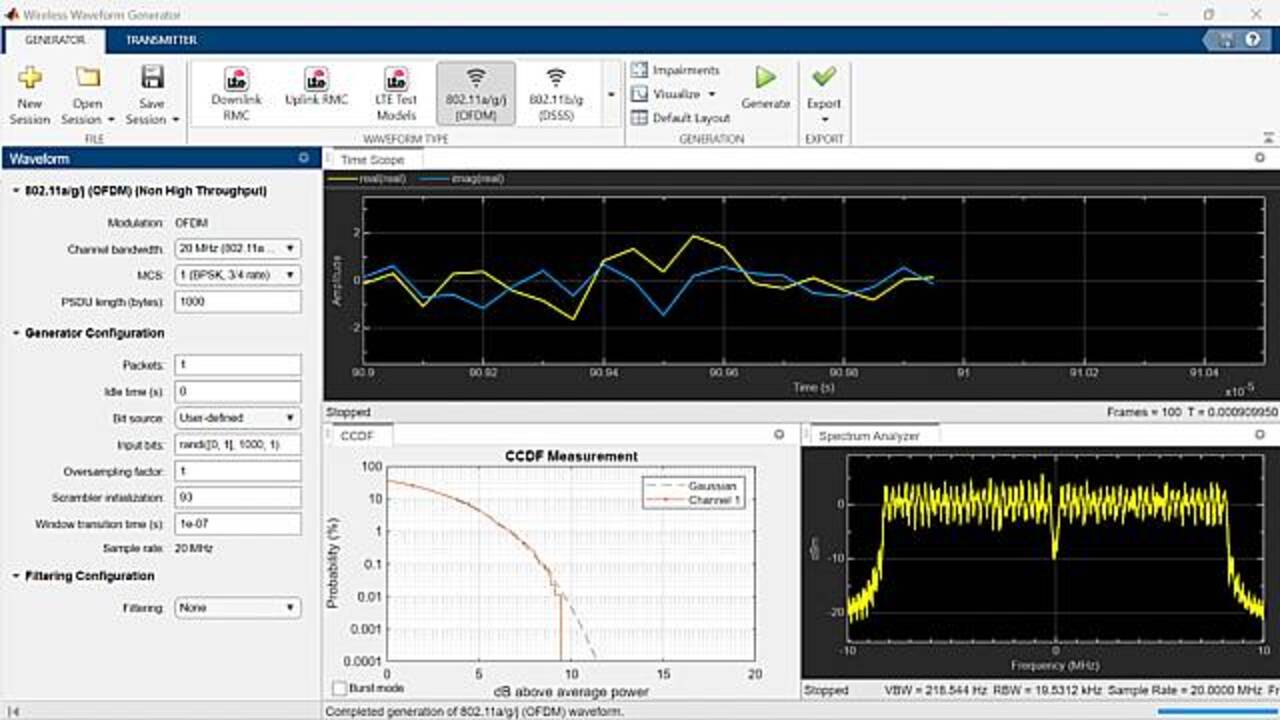
- The Wireless Waveform Generator app creates custom or standard-based physical layer waveforms.
- Design verification supports over-the-air (OTA) testing with Software-Defined Radios (SDRs).
Why It Matters
This update equips engineers with a more comprehensive environment for wireless system development, from design and simulation to verification. The integration of AI and advanced propagation modeling addresses increasing complexity in wireless communication, particularly for emerging standards. Expect this to enable faster iteration and optimization of wireless system designs, impacting development cycles for various streaming and connectivity hardware. The next data point to watch is how quickly these capabilities are adopted across major hardware development teams.
Additional Context
The release of MathWorks' Communications Toolbox with enhanced AI and acceleration features comes at a time of broader updates across the company's product suite. MathWorks' R2026a release also introduces new products like the Wireless Network Toolbox and significant updates to others, including RF PCB Toolbox and RF Toolbox (per MathWorks, June 2026). Notably, the Communications Toolbox Wireless Network Simulation Library has moved into the new Wireless Network Toolbox, streamlining network-level modeling (per MathWorks, June 2026). Simultaneously, MathWorks recently highlighted RF Digital Twin workflows for radar and satellite communications at IMS 2026. This initiative integrates validated RF hardware models from Analog Devices into system-level simulation, aiming to enable earlier design verification of complex radar and satellite communication systems. Leonardo, an aerospace and defense company, is an early adopter, using these digital twins for advanced radar programs (Business Wire, June 2026). These parallel efforts indicate a strategic push by MathWorks to provide comprehensive simulation and verification tools that span component-level RF design to system-level communication networks, with a clear emphasis on leveraging AI and robust modeling for complex wireless environments.
Read full article at mathworks.com