

Christie Unveils Spyder-S 6.1 for Massive 200 Million Pixel Canvas Productions
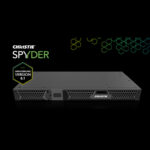
Christie has released Spyder-S 6.1, an update to its video processing platform, enhancing connectivity with new DisplayPort 1.4 and SFP Frames. This expansion aims to support more complex productions for rental, staging, live events, and fixed installations. The platform offers increased flexibility, scalability, and performance for demanding live environments.
Key Takeaways
- New DisplayPort 1.4 Frame supports background inputs up to 7680×2160 at 60Hz for high-resolution sources.
- Integrated SFP Frame provides 12G-SDI and HDMI 2.0 support with fiber capabilities for long-distance signal runs.
- Modular architecture allows the system to scale from a single 1RU node to 16 linked frames without altering software workflows.
- Enhanced Configuration Manager adds testing tools and source monitoring for mix effects (MEs) to safeguard live switching.
Why It Matters
The upgrade addresses the growing requirement for massive, high-bitrate visual canvases in the immersive entertainment market. By expanding modular connectivity, Christie lowers the total cost of ownership for rental and staging firms that previously relied on monolithic, fixed-input hardware. This shift toward FPGA-based, distributed processing reflects a broader industry move to bridge the gap between high-end broadcast standards and flexible live event infrastructure. Strategists should monitor adoption rates among major sports venues and broadcast sets, where the 200-million-pixel threshold is becoming a baseline for immersive fan experiences. Watch for whether competitors like Barco respond with similar high-bandwidth modular expansions in the 8K processing segment.
Additional Context
The release of Spyder-S 6.1 aligns with Christie's broader strategic shift following a period of reorganization. Per AV Network (February 2026), Christie Digital Systems recently reached an agreement to sell its Broadcast and Professional Video business—including the Spyder, Terra, and Phoenix product lines—to Vista PHX. This new entity, led by former Vista Systems owners, intended to return the video processing technologies to an independent, specialized management team to accelerate platform investment and engineering agility. Simultaneously, the live events vertical is experiencing a significant surge in demand. According to AVIXA projections (February 2025), venue and event revenue is expected to grow to $57.2 billion by 2029, making it the fastest-growing sector in the professional AV market. This growth is driven by the 'Experience Economy,' where corporate lobbies, stadiums, and themed entertainment centers increasingly require high-density LED videowalls and real-time content compositing. Technologically, the industry is transitioning toward network-native designs. Per reports from InfoComm 2026 (June 2026), the convergence of AV and IT remains a central theme, with a heavy emphasis on AV-over-IP standards like IPMX and SDVoE. Christie’s inclusion of SFP frames for long-distance fiber runs and modular 100G network connections between nodes positions the Spyder-S platform to compete directly within this evolving ecosystem, prioritizing scalability and deterministic low-latency performance in increasingly complex IP-based production environments.
Read full article at lsionline.com